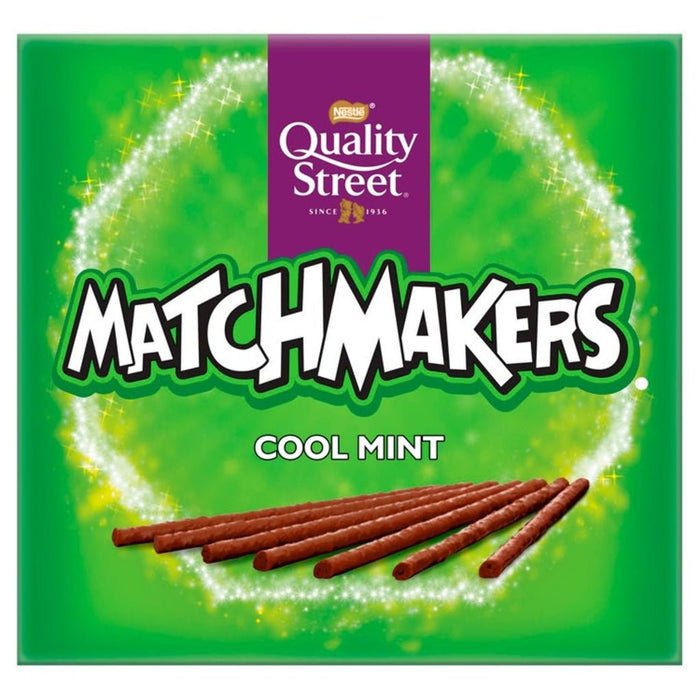
A Quality Street relation, not the whole tin
There is no supplied product-level origin story here for Matchmakers Cool Mint, so it would be cheeky to pretend we can pin it to a neat first day, first maker or heroic factory anecdote. What can be said honestly is that the modern packet belongs to the Nestlé Quality Street world, a brand family British shoppers know from Christmas tins, grandparents’ sideboards, office kitchens and the annual domestic argument over which sweet gets left until last. Matchmakers are not the same thing as the classic mixed tin, of course. They are the slimmer, after-dinner cousin: still recognisably part of that British confectionery landscape, but with a different job to do.
The Nestlé name, by way of coffee, milk and a lot of British cupboards
Nestlé introduced instant coffee to the UK in 1939 under the Nescafé brand, which had first launched in Switzerland on 1 April 1938. The name Nescafé itself is a blend of “Nestlé” and “café”, which is exactly the sort of tidy naming corporate history likes to preserve. By the 1970s, Nestlé held around half of UK coffee production, and by 2000 it was reported to have a 56% share of the UK’s £650m coffee market. That may sound a long way from mint chocolate sticks, but it helps explain why the Nestlé name became so familiar in British kitchens. It was not just on chocolate. It was on jars, tins, cupboards and shopping lists, doing the slow work of becoming ordinary.
Before the modern packet, a rather tangled family tree
Nestlé as a company was formed in 1905 through the merger of Henri Nestlé’s Swiss milk-food business and the Anglo-Swiss Condensed Milk Company. Henri Nestlé’s earlier work in Vevey centred on a powdered milk-based infant food sold as Farine Lactée Henri Nestlé, while Anglo-Swiss had roots in condensed milk and opened a British operation at Chippenham in Wiltshire in 1873. None of that means Henri Nestlé invented Matchmakers, and we should all resist that sort of nonsense. It does, however, show why milk, chocolate and British food manufacturing have long been woven into the company’s story, even before later confectionery acquisitions made the packet names more familiar to shoppers.
Where Rowntree and Mackintosh enter the picture
The Quality Street name comes through the British confectionery line that later became part of Nestlé. Rowntree’s was founded in York in 1862 by Henry Isaac Rowntree and became one of Britain’s major confectionery makers. Rowntree developed names such as Kit Kat, Aero, Fruit Pastilles and Smarties, while Quality Street and Rolo came into the Rowntree story through the 1969 merger with Mackintosh’s. Nestlé acquired Rowntree Mackintosh in 1988, bringing a set of very British sweet-shop names into its portfolio. That is the useful bit of corporate history here: it explains why a product sold today under Nestlé can still carry the emotional furniture of British confectionery rather than feeling purely Swiss on the shelf.
Why it still matters in Canada
For British expats in Canada, Matchmakers Cool Mint is not usually about grand heritage. It is about recognition. It is the box that feels right after Sunday dinner, the one that turns up in family parcels, the one people remember from Christmas visits when the grown-ups said “only a couple” and then mysteriously had several. In Halifax, Dartmouth, Toronto or Calgary, that matters more than any polished brand timeline. Some groceries travel because they are essential. Others travel because they remind you of a room, a relative, a cupboard, or the particular British habit of pretending mint chocolate is practically a palate cleanser. Quietly, that is why The Great British Shop keeps this sort of thing within reach.